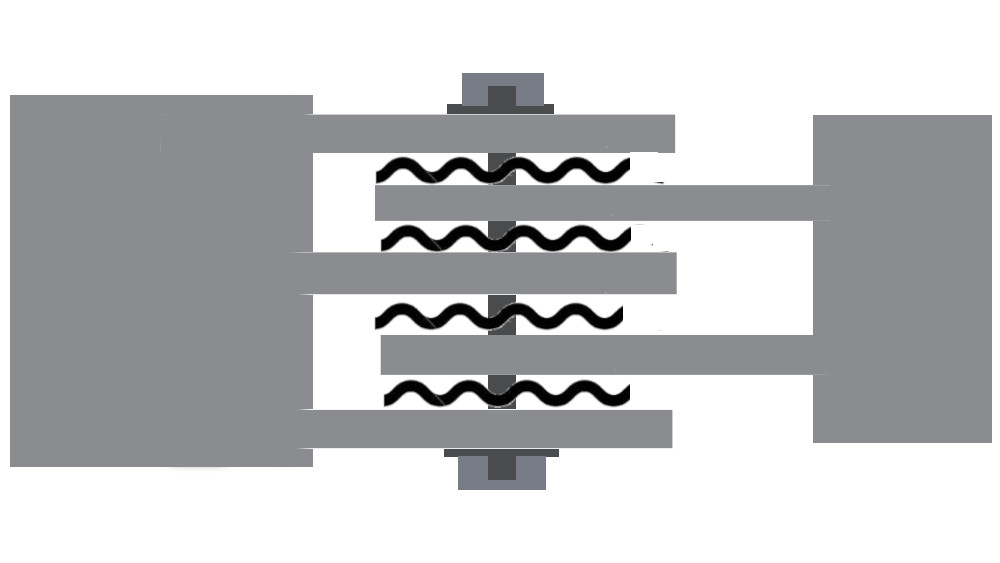
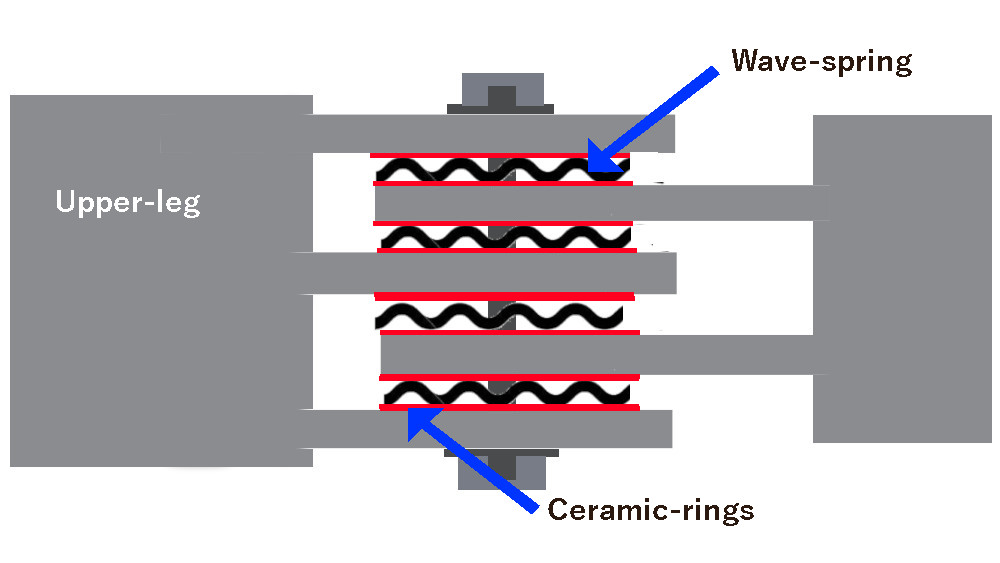
Has anyone ever thought about a joint system (arms, legs, etc.), with bump-like rings placed in it instead of the plastic-silicone rings, which would then act as a spring when the nuts are tightened.
Sounds like a very stable/reliable and durable solution for joints and… very cheap to produce as well.
Should be good if the dollworld can upgrade the skeleton with not any changes to make into the skeleton, but just to start other rings into the skeletons for example.
How does this sound and what other very very good options can be found?
The common cause of loose joints is wear on the bearing surfaces (material loss) rather than fasteners (bolts) loosening (unthreading), since they are often tack welded in position. The wave springs/spring washers would likely take up that slack but not forever and they may even cause accelerated wear. It would have to be tested with many cycles.
I’m not a materials engineer, but wouldn’t the continual tension (compression, I guess?) cause those to still fail/flatten eventually? Or just the grinding force of the metal bits against the discs?
Also, would it cause a weaker joint when it comes to lateral movement (so a downward force in your picture?) You’d definitely need some sort of locked/welded nut on it to prevent it from loosening - that much I can tell you based on what I know.
With that said, some innovation on skeletons sounds like it’d be a good idea. It’s certainly possible there’s some sort of improvements to be had - I think there’s some manufacturer doing some sort of geared skeleton (Starpery maybe?) that seemed interesting when I saw it, for example.
I think an interesting question is, what would a “perfect” joint system look like? If cost wasn’t an issue (within reason - I think a lot of folks here would pay $300 extra or more for a super-awesome skeleton but probably not $1000 or $2000 or more,) what would it look like?
If I had to lay the ground rules out for a good joint, ignoring (for the moment) needs of the surrounding material:
Flexible - needs to have at least a human-like range of motion, if not more (to get into those really fun positions)
Durable - The joint needs to stay at its factory-set tightness within a small margin - it shouldn’t loosen or tighten too much under normal use.
Consistent - No matter the price, it should be able to be mass-produced at least as far as the skeletons already are so that any two skeletons are the same.
I’m not sure off the top of my head what’d be more effective than the ball-and-joint, but the above is what I’d say is a starting point.
Yes agree not forever, but nothing is forever.
However I think it would stay already way longer good by using such wave spring ring (thx for the right English word).
But… if want to make it very very long durable, it can be done even with ceramic rings into it as well for to protect surfaces.
Every invented system will end one day, but wave spring rings does do a bit the same like the ball joint spring for hands, for hands its a good system, but too weak for to use it into legs for example.
The drawing I made is a very simple one to show what it looks like, of course many changes can be made to this to counteract lateral forces by having sturdy bushes in the center of the wave springs.
the wavespring also ensures that there is always an equal counterforce on the joints, even if they wear slightly, but in my post before I mentioned ceramic rings, that is very very durable.
Most important, the skeleton doesnt need to be changed for, so its a very easy change for a manufacture and maybe and possible willing to try this.
Even, if someone does bow an arm or leg on the wrong way, wave-spring rings dont give that much about, platic/silicone-rings do… a lot, bc its actually done if it happens.
Skipping over the rest, because I don’t actually know enough to refute it, my thought here was more bending the thinner metal vs. breaking the wave-spring.
Maybe there’s someone around who has the materials to experiment with it.
Yes the type of steel is not just to take steel, it have to be such steel what is also into those wind-up toys, its steel that can bow a lot and comes back as the pressure decreases, but can break indeed as well, so to use pins as spacers the thickness of the metal that is allowed to wear off, because it does not need to go further, bc when its at that point, the joint is worn out, just like any other system what will worn out way earlier.
But also, no need to have such huge wave I did in the example, a wave of half a mm will be already more then enough and that will protect the rings already as well.
I meant the thinner metal attached to the joints, not the springs themselves - the “fingers” between the springs. Although as you said in your other post, it sounds like the springs don’t actually have to be super thick - which would reduce that worry for me.
I think it was mostly the scale of the drawing that was throwing me off.
Since doll skeletons are tubular, put a compression spring into the tube that acts on a piston (a bit like a valve in a car engine.) The piston would then be forced towards the adjacent part of the joint, acting like a brake keeping the joint tight.
I hear you and yes the drawing was just for to show it way over the top what I was meaning with those flat wave springs.
The fingers between the springs, is what I was meaning with ceramic thin rings placed between the fingers and the wave-springs, ceramic is very very durable.
Do you mean a bit like a pleumatic system or like how wrists are done to dolls, a ball-joint with a spring?
I think a ball-joint spring will not hold legs for example, its great for fingers and a wrist, but if there is too much pressure due to weight, then I think this will be the least suitable system.
Imo probably the best and easiest solution would be to just keep the existing system; but instead of tack welding the nut to secure it, use a nyloc nut or similar and place small removable plugged holes (like is done for back hanging hooks) so the user can use sockets to tighten as necessary without having to cut into the doll. Doing it this way requires little to no added complexity or cost. No matter what material they use; it will wear, whether that is the bushing or other components.
Ball joints and gears are likely the worst options since there is no way to tighten the fit once worn other than to replace components.
I have certainly thought about this and personally I would also think this is an excellent method, but I am sure that many people will not appreciate the fact that many finishing skin plates/plugs go over/into the holes.
Another problem will be that dirt, etc., can get into the silicone if customers all the time gonna work on the skeleton, it may even start to tear… and other people will use the wrong tools to try to fix something, causing something to break. I know this is someone’s own responsibility, but a skeleton with all its joints should work fine with the same force always needed to bend a leg, for example.
That’s similar to a suggestion i had at the other place. Make the big joints - ankles, knees, hips, elbows, shoulders - adjustable with a screwdriver or something similar, open a small hole from the skin into them, and use a removable silicon plug to seal the hole.
My suggestion is to have the cap on that plug look like a mole so itll be spotted easily and not look unnatural against the skin.
Obviously a better solution is to redesign the joints for far greater durability. But this would seem to be a very workable interim improvement.
It’s a traumatic experience having to cut a doll open. She’ll never look the same, and once those joints loosen they’re doomed to come loose and require surgery again.
To be honest this is indeed as I said already before, maybe the best option at the moment, but the edges of those plugs will gonna be dirty and all after a while, maybe faster then we think this will happen, the moment those things happens it isnt invisslible.
But for now, yes I think the best option to do, but for longer term they really must work on better joints in mine opinion.
On the other hand, why to have an option for pose and loose joints, by doing it yourself (with openings and plugs) everyone can do how they want to have the joints.